SUPPORTERS
Samuel Oldham, acting Board Chair of Mt. Carmel Ally said, “ “I am pleased to see there is a group taking on this task. They seem to be moving forward for unselfish reasons and I wish them great success!”
-Samuel Oldham,
Mt. Carmel Ally
Luther Dickinson of the North Mississippi All-Stars said:
–Luther Dickinson
Furry Lewis sang, “ There is one kind favor I ask of you, see that my grave is kept clean.” Furry Lewis made this plea most every time he performed. Furry Lewis was a friend and mentor to countless musicians and loved by the Memphis music community as well as influencing country blues musicians around the world. We owe it to him to honor his wishes and take care and tend to his gravesite. I support this cause wholeheartedly.”
(Sons of Mudboy and North Mississippi Allstars)
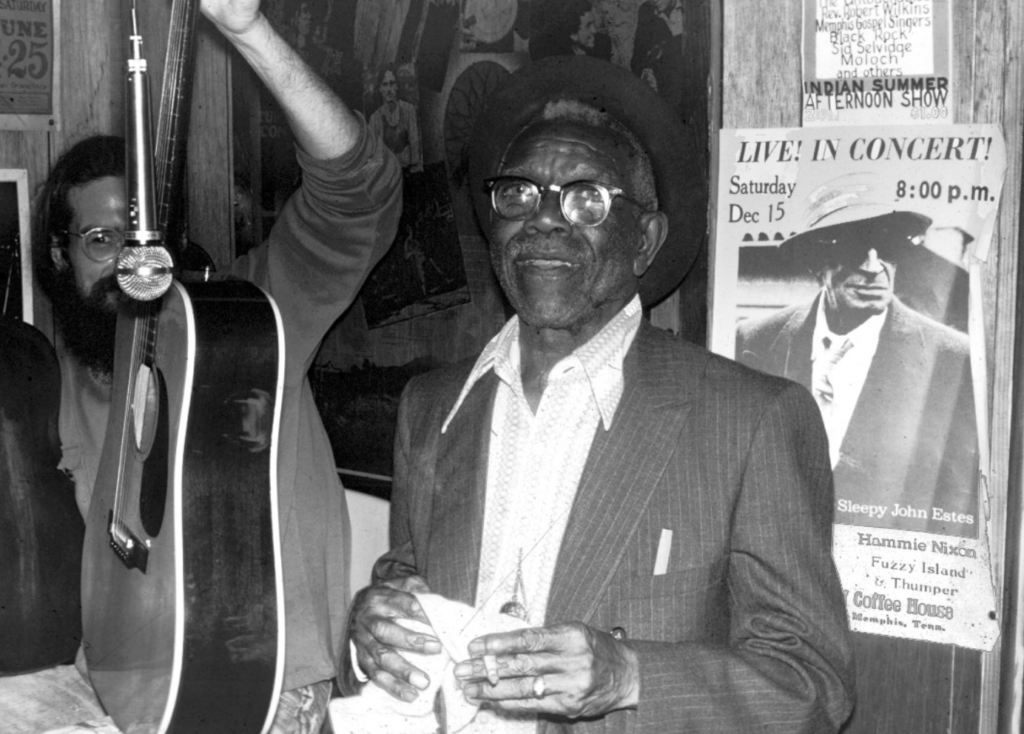
Musician, filmmaker and writer Tav Falco says:
–TAV FALCO
The Country Blues Festivals in the 1960s at Overton Park Shell were monumental and their influence enduring. Among the performers was perennial favorite, guitarist Furry Lewis who, since he lost his leg in 1916 working on the Illinois Central Railroad, had eked out a living sweeping the streets of Memphis, and playing around town with his guitar. What first drew me from the hills in Arkansas to those festivals riding on a Trailways bus was an album recorded by Samuel Charters in 1959 in Memphis for Folkways Records. The voice of Furry and his lyrical guitar
picking combined with those Shell shows were what motivated me to move to Memphis. I followed the music… and lingered there for 17 years.
Musician, Filmmaker, Writer
In my book, Ghosts Behind The Sun: Splendor, Enigma, & Death, Mondo Memphis Vol I, Connie Edwards talked about a limo ride in the back seat with Furry. (She was a go-go dancer at Tiffaney’s tittie bar out by the airport and a performer in Big Dixie Brick Company art-action group that poet Randall Lyon & I had formed with her & her go-go side-kick, Marcia Hare.)
“Oh, you know when the Rolling Stones played in Memphis last time, Furry Lewis and I were in the back of the Stones’ limousine, and they pushed me and Furry in the back of it, and it was hurting our legs even though we were the shortest. Furry was afraid they were gonna pop his artificial leg off, while the promoter, Irving Salky, and the fat cats have the big seats up front. Then Furry kept pushing the seat and telling them, ‘Man, get up. You’re hurting my leg. You’re gonna pop it off.’ And then he turned to me and whispered in my ear, ‘Good God, man, does Barnum and Bailey know about you people?’ I started laughing. The more I’d laugh the more Furry would tell me, ‘Don’t you tell ‘em now, don’t you tell ‘em.’ And the more he’d tell me don’t tell ‘em, the funnier it became. Irving and his cronies were turning around, ‘What’s he saying to you?’ I said, ‘I’m not telling.’ Even though Furry was going to open the show that night at the stadium, he didn’t want them to get no pleasure out of his company right then, ‘cause they were about to pop off his leg.”
Bunch of whitebread gringos, thinking they could put Furry Lewis in the backseat. They got him in the back of the bus again.”
Musician and record producer, Jim Dickinson, spoke with me about band mate, Lee Baker, who was a white guitarist that had taken up with Furry.
“Procopé was another venue that was like a folk venue but also had blues where Lee Baker and Furry Lewis played. They’d become almost inseparable.
“Again, I’d fought with him about that. I said, ‘Baker, Furry is so much
better without you.’ He said, ‘I don’t care – I’m playing with him anyway.’ And of course it became necessary, I mean, for Furry really needed Lee. But at the beginning it was like, just Lee, you know, here I am; I’m playing.”
He took Furry to that movie set in Nashville. Whose movie was that? It was Burt Reynolds – W.W. and the Dixie Dancekings. ‘Uncle Furry’ they called him!” Lee told me that they tried to pay Furry with a check that day after filming, and Furry pulled a knife out on them. He didn’t take no checks. The director – whoever he was – was giving Furry heat about drinking. ‘Cause Furry drank a pint of whisky every day – that’s what killed him. They put him in the hospital, dried him out, and he died. But the guy was giving him heat about his drinking and finally Furry said, ‘Lookie here, mister, I could be drunk. Point is: I’m not drunk, but I could be drunk.’ The next day Burt Reynolds brought him a fifth of whisky, in front of the director. Oh, Furry was a force of nature, man. He took Baker with him when he played on The Tonight Show promoting that awful movie, which really is a terrible movie, and Lee showed up with him, and they didn’t – oh no – want to see no white boy on the screen, so they made Lee sit over with the Tonight Show Band. He was miked and everything; you could hear him, but you couldn’t see him. Furry did ‘Going to Brownsville’. In the middle of the song he stopped for the solo, and by this time Lee was taking the solos. Furry was just kinda hangin’ out. So Lee is getting in the solo and Furry says – you know he called him Lee Bailey, inexplicably he always called him Lee Bailey – he’s in the middle of the solo and Furry says, Po’ ol’ Lee Bailey.”
“ So Furry was a Midtown musician, right?”
“Downtown.”
“Downtown? ‘Cause the place he was burned out in, I thought was in
Midtown.”
“It was closer to Midtown, yeah, but when we first did the Blues Festival he was living on Fourth and Beale – same place as Will Shade.”
“Oh yeah, and Van Hunt.”
“Van Hunt lived there, too. It was like an old blues guys’ retirement
home, almost. Fourth and Beale – that had been one of the famous whorehouses.”
Memphis filmmaker and writer Robert Gordon said: “Cleaning cemeteries is a simple matter of respect for the dead, no matter who they are. Factor in the tremendous artistic achievement followed by a life in obscurity that most of the blues artists experienced, and serving their memories becomes an honor. These musicians created the foundation of our popular music culture—American culture, world culture—and American racism kept them from ever getting their due. Respecting their memories, and cleaning their burial sites, is a small way to pay respects to their large contributions that they made to the pop culture that we enjoy today.”
–Robert Gordon
Memphis filmmaker and writer
Filmmaker Augusta Palmer said, “The music of Furry Lewis has enriched my life immeasurably, and I love watching (and listening to) him. It’s vital to assure that his grave is kept clean. Moreover, everyone buried in Hollywood Cemetery and Rose Hill Cemetery matters. Preserving Black cemeteries is not only a much-needed sign of respect and remembrance, it’s also vital to Memphis history, Southern history and American history.”
–Augusta Palmer
FILMMAKER
Dom Flemons said:
–Dom Flemons,
Dignity is the word I would use. For it is dignity that allows a person to feel at ease in their own skin. When a person walks this Earth, if their dignity stays intact they can hold their head up high knowing that they are respected and that their existence is worthwhile to the world around them.
But what happens to a person’s dignity after they die? All that is left are the memories shared by the people they touched through their thoughts and their actions in life. And in return, if they are so fortunate, they have a community of people around them that will facilitate their burial, leaving a stone to denote their final resting place.
The American Songster,
03.02.2026
In the blues, there are many great master storytellers who have fallen and were buried unceremoniously. They are laid to rest without their dignity and without a marker to show where admirers of their works may visit and meditate on their legacy.
It may be the inevitable fate of the bluesman. One of the most famous lines sung in the blues was sung by the great Blind Lemon Jefferson when he sings,“Did you ever hear that church bell toil?/ It means another poor boy is in the ground.”
He is reserved and cognizant of the inescapable concept of death. Yet, to give this line its full context, one must spin the record back to the beginning and hear him sing the opening verse which again talk about dignity: “Well it’s one kind favor I’ll ask of you/ Please see that my grave is kept clean.”
The song is now a century old and like any poignant artifact from our collective past history we must heed the wishes of the dead. This is why it is important to nurture and cherish the gravestones of these great bluesmen. They have laid their burden down but it is the job of each generation to pick up that burden.
We must clear a path for future generations to ponder the physical space held by these working musicians now that they are gone. The time taken to clean their graves gives them the dignity of being seen in ways they may not have been in their lifetimes. It also generates the energy needed to extend a hand across time to show the sanctity of the human race across social barriers through the confines of the time we are allotted on Earth. While one can discuss a gravestone and its importance, there is nothing like standing at the literal stone taking in the name, the dates and the message in its epitaph. It takes a lot of work to clear the path and I encourage everyone to lend a helping hand.
Thank you for giving the blues its dignity so that it can sing again across the fields and the concrete streets of our modern world. We continue to need those lessons to rise up and transcend the hardships of life.